
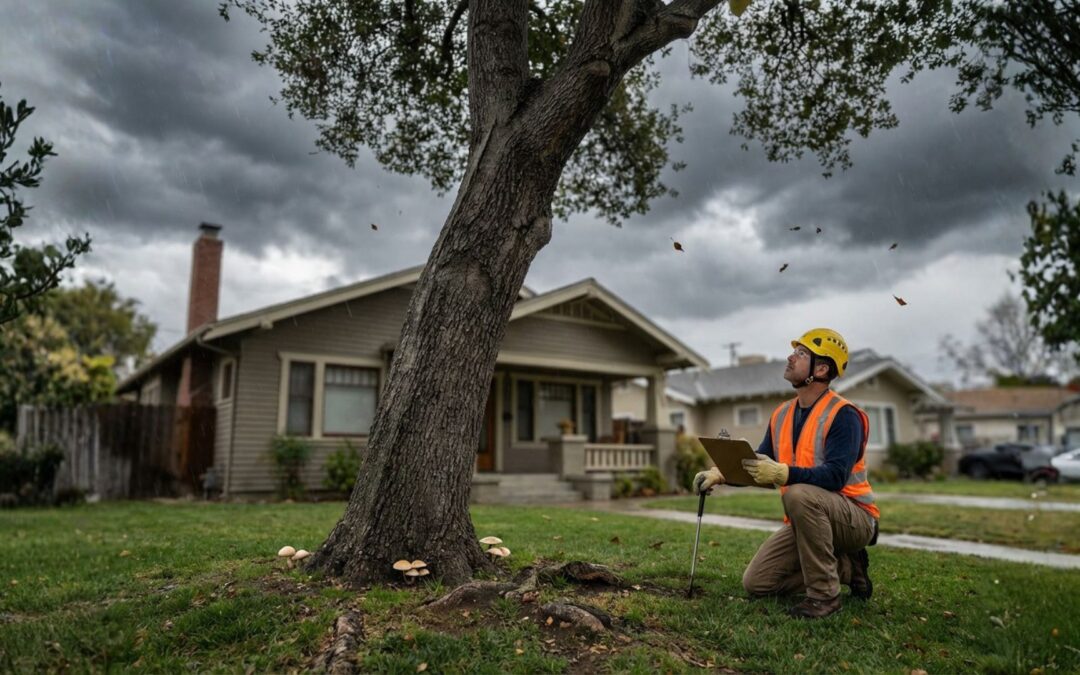
Storm season in California is nothing to joke about, especially if you have large trees around your home that may not be in the best condition. That’s why having a tree assessment done is not only a good idea, it’s a proactive step you can take to make certain that your home is safe. You should never underestimate the damage a falling tree can do. That’s why the team here at Alan Quality Tree Care has put together this short guide on identifying hazardous trees.
Why Hazardous Tree Removal Matters in California
What is considered a “hazardous” tree? Basically, any tree that has damage or other defects that could cause it to fall. Here in California, we often see a one-two punch of drought followed by heavy rain. This can weaken a tree’s root system, causing it to no longer have the foundation it needs to remain upright in high winds.
How to Identify Hazardous Trees
Fortunately, you don’t have to be a tree expert to spot some signs of a hazardous tree. First, look at the ground: has the dirt around the base of the tree changed? You want to look for dirt that appears to have been lifted up on one side. This shows that the root plate of the tree has shifted.
Other warning signs:
- Fungus – If you see mushrooms growing in a line that follows the roots of the tree or growing around the tree’s base, it can be a sign of root rot.
- A slanted trunk – Healthy trees grow towards the sun. While a curved top is often fine, if the trunk itself is slanted or tilted so that it’s more parallel to the ground than perpendicular, it’s a good sign that the tree can’t hold its crown up towards the sun.
- Pests – Various pests such as the Mediterranean Oak Borer (an invasive beetle) can quickly spread from tree to tree. Once infected, the trees can lose integrity and die in as little as three weeks.
The Tree Hazard Assessment Process
When you call us out for a professional tree hazard assessment, we probe the tree to understand what is going on inside and out. We will create a list of potential hazards based on what they might hit if they fell. This documentation is often necessary for insurance purposes, especially if you have any protected California species on your property, such as the Western Sycamore or the California Bay Laurel.
Managing and Removing Dangerous Trees
If we find that you have a tree that is dangerous, we usually recommend you take action as soon as possible. In California, you may need to have a permit to remove a tree, especially if that tree is protected or is a heritage tree. Getting these permits can take time. However, if it’s clear that the tree is an imminent threat to your safety, emergency tree removal can often bypass the standard permitting process. This depends on the tree and your situation, so you can’t always count on skipping permits.
Emergency and Fallen Tree Removal After a Storm
If the worst happens and a tree falls during a storm, don’t try to deal with it yourself, especially if the tree took down any power lines or fell on your home. Instead, you want to call for a professional. We understand how to remove trees safely while minimizing any additional damage.
Proactive Maintenance and Prevention Tips
Here are a few tips for proactive maintenance:
- The 12-foot rule – If a tree is less than 12 feet tall, you can usually do basic pruning yourself. You can find proper pruning standards at ISA. If it’s over 12 feet, give us a call.
- Early detection – If we catch root rot and other issues early, we can often save the tree or, at worst, remove it before it falls.
Don’t wait for storm season to start – call Alan Quality Tree Care today to schedule a professional tree hazard assessment.